
The concept for the BioXAS project has evolved largely from the scientific research programs of two Canada Research Chairs: Drs. Graham George and Ingrid Pickering. Their work focuses on the usage of X-ray absorption spectroscopy (XAS) and X-ray fluorescence imaging (XFI) techniques to further the study of the roles of metals in biological processes and in the environment. In particular, George and Pickering have excelled at improving the sensitivity of these types of experiments to dilute concentrations of metals such that the experiments can be performed at biologically and physiologically relevant concentrations of the metals.
Having agreed to move to the University of Saskatchewan, home of the Canadian Light Source, George and Pickering set out to prepare a proposal for a multi-beamline project, to be built at the CLS, with the intention that the beamlines would be optimized to produce performance characteristics ideal for the study of metals in biological samples and systems. After submitting a project proposal to the Science Advisory Committee of the CLS, George and Pickering in conjunction with the U of S, submitted a funding application to the Canadian Foundation for Innovation (CFI). The support of the U of S and the province of Saskatchewan meant that funding awarded by CFI would be matched by the province of Saskatchewan. A favorable decision to award CFI funding was received, and the project proceeded.
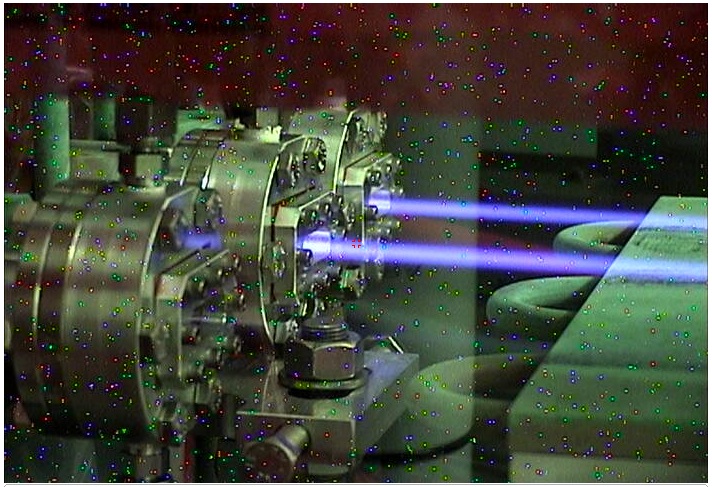
The picture above was taken during radiation testing on the BioXAS beamline: The pictures are of a scatter target that is located immediately downstream of the front end. The Beam is traveling through a set of Beryllium windows and striking a copper scatter target. The area of the windows/target is enclosed in a nitrogen filled tent to cut down on the creation of ozone. In all cases, the images are somewhat pixelated. The camera is getting bombarded with radiation which leads to the pixelated image when the beam is active in the hutch. (With the beam off, the picture is nice and crisp.)